|
Texas Southwest CouncilTexas Southwest Council Website San Angelo, TexasMr. A. C. Dunn, deputy regional executive, working under James P. Fitch, Region 9 Executive, met with the Board of City Development and later with the Kiwanis Club in mid-July, 1922, to urge the group to hire a paid executive for the Tom Green Scout Council. An executive had already been hired in Abilene to carry on the work there. Apparently his request got nowhere as it was not until 1926 before a paid executive was hired. The six troops, with membership ranging from twenty-five to thirty-two boys were: Troop 2
- South Side Baptist Church - Rev. J. H. Garrett,
Scoutmaster The Scout registration fee was 50 cents. The dues were from 25 to 50 cents a month and a uniform, including leggings, trousers, shirt and hat, could be purchased for $7.50. Scouting was apparently still active in 1925 although no record could be found on any activity that took place in the paper. The Kiwanis Club continued to discuss their support of the program and what they could do to make Scouting a valuable part of the San Angelo scene. Council Formally OrganizedThe Concho Valley Council, Boy Scouts of America, was formally organized on Thursday afternoon, May 20, 1926 by E. E. Voss, Deputy Regional Executive of Texas, Oklahoma and New Mexico. Voss told the group that the Concho Valley Council charter would come through in a few weeks at which time he hoped to return for the formal presentation. An office was opened at 105 1/2 S. Chadbourn. Brice W.
Draper John Y. Rust.
..
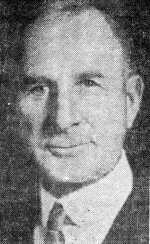 John Y. Rust
served as its first president from 1926 to 1931
inclusive. He was succeeded by Houston Harte who
served through 1935. We know that Sam
Scheuber served as Council Commissioner through
1932. Both John Y. Rust and Sam Scheuber
received the Silver Beaver award in the early '30s for
"Distinguished Service to Boyhood" from the Concho
Valley Council. John Y. Rust
served as its first president from 1926 to 1931
inclusive. He was succeeded by Houston Harte who
served through 1935. We know that Sam
Scheuber served as Council Commissioner through
1932. Both John Y. Rust and Sam Scheuber
received the Silver Beaver award in the early '30s for
"Distinguished Service to Boyhood" from the Concho
Valley Council.
The name "Concho Valley" was selected because much of the original territory of the council was in the valley of the 'general prongs' of the Concho River (Spanish for shells, found in the river). The middle branch of the Concho River rises in Reagan County; the south branch rises in Schleicher County. The north branch rises outside the territory and flows southeast to unite with the Concho River which is formed at San Angelo and continues eastward through Tom Green and Concho counties and joins the Colorado River. The headquarters for the Concho Valley Council has been located in San Angelo since the council was organized in 1926. Charter Members of CouncilA Scout House CompletedScouts at Ben FicklinThe group of boys was divided into two groups and the game of "Crows and Cranes" was played, followed by an Indian dance with "blood-curdling yells." J. W. Scheuber, Ed F. Johnson and Fred Cox tasted the meat and potatoes the Scouts had prepared over twenty-eight fires, all in three long lines. In early March, a training course for adults was held for fifty men at the Elk's Hall to get men interested in promoting the Scout organization in San Angelo. The patrols were Clyde Hoyt's "Roosters", the Ed F. Johnson's "Foxes", G. H. Odam's "Wildcats", Sam Scheuber's "Cuckoos" and Jean Cornelison's "Beavers." Patrol Leader TrainingJunior Leader Training, Christoval,
Texas in 1928.
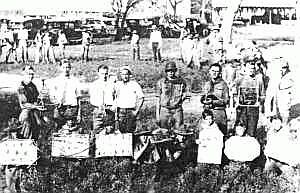 This event was
followed by a Scout patrol leader's training
conference on March 20 and 21 at Christoval with sixty
Boy Scouts in attendance. Involved with helping
with the training of the youth were City Manager E. V.
Spence, Dr. J. P. McAnulty, Rev. E. V. Evins, Rev. G.
W. McCall, and Chief Parker of the San Angelo Fire
Department. By this time they had organized
eight troops in town. This event was
followed by a Scout patrol leader's training
conference on March 20 and 21 at Christoval with sixty
Boy Scouts in attendance. Involved with helping
with the training of the youth were City Manager E. V.
Spence, Dr. J. P. McAnulty, Rev. E. V. Evins, Rev. G.
W. McCall, and Chief Parker of the San Angelo Fire
Department. By this time they had organized
eight troops in town.
Neal Sanders was patrol leader of the "Roosters", J. T. Sorrells of the "Eagles", Norris Creath of the "Lions" and Charles Kirkpatrick of the "Owls." Saturday afternoon the Scouts passed all Tenderfoot tests, studied and recited on two instruction sheets on leadership training, learned to signal, and made patrol totems with material gathered on the grounds. After dinner they heard a lecture on First Aid, tied Tenderfoot bandages and attended a campfire. Taps was heard by a tired camp at 10:15. Sunday morning, following calisthenic drill intermingled with lusty songs, they ate breakfast, heard a lecture on leadership ability, worked on second class tests, heard Chief Parker speak on ways they could help the fire department, procured a patrol mascot, ate a "huge chicken dinner" and continued work on their second class tests. An inter-patrol field meet was held at 4 p.m. with contests in first aid, fire building, potato cooking, wall scaling and patrol unity. The Lion Patrol edged out the Owls by 2 points. Hundreds of cars carried spectators to the field meet and many of them expressed surprise at the knowledge the Scouts had gained during the conference. A second Patrol Leaders conference was held at Christoval on April 17 and 18th and was aquatic in the most part, closing with a water carnival. Districts OrganizedThe San Angelo Standard-Times announced on December 7, 1930, that Waldo Williams was field commissioner of the Western District composed of the counties of Pecos, Crane, Reagon and Upton and that A. W. Boren of Brady was field commissioner of the Farm district of the counties of Concho, McCulloch and Menard.
An story in the Dallas Morning News, March 22, 1914, recently discovered, told of two Boy Scout Troops in Ballinger in 1914 that were presented two large flags, 4x6 feet, as prizes, for their participation in helping to clean up Ballinger in the clean-up campaign fo the city. In the meantime, the Southwest Council was organized in 1926 by John C. Campbell as the organization executive. In late 1926 he joined the regional staff as deputy and M. M. Fulmer became the Council Scout executive. In 1927 H. B. Palmer became the executive and continued through 1935. The Council lasted for only ten years, until it merged with the Concho Valley Council in 1936, but during that time it was a very active council serving ten counties in southwest Texas. In 1936 this council was on direct service for a few months, then was joined with the Concho Valley Council. Counties included Val Verde, Edwards, Kinney, Uvalde, Real, Dimmit, Maverick and Zavala. The Concho Valley Council serves 23 1/2 counties in West Texas today with four districts and a staff of four Executives. The office has been located at many different places in the downtown area of San Angelo. For a list of where all the offices have been located since 1927 to HERE. Internet RecharteringNew Council Name
Go HERE
to view Texas Southwest Council Facebook page Texas Southwest Council Other Pages | Presidents | Scout Executives | Other
Executives | Map of Council
| Offices |
Cub Scouts | Senior Scouts |
Material for this page came from "History of Region Nine, Boy Scouts of America, 1920-1967," by Minor Huffman and "Panjandrum, A History of Scouting in the Concho Valley Council 1911 - 1941," by Frank T. Hilton, 1990 Last
Updated: April 12, 2023 |
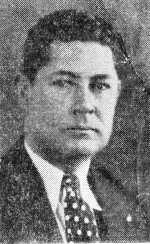 The new council
was composed of sixteen and one-half counties: Tom
Green, Irion, Schleicher, Sutton, Kimble, Menard,
Concho, McCulloch, Crane, Reagan, Cole, half of
Runnels, Terrell, Pecos, Crockett, Upton, and
Graner. It was organized primarily through the
efforts of John Y. Rust, Houston Harte, and H. C.
Ragsdale of San Angelo. By
February 18, Brice W. Draper, son of H. E.
Draper, presiding elder of the Methodist Church, was
employed to be the Scout Executive. He was
transferred from the Nueces Valley Council of Corpus
Christi. Brice W. Draper served as Scout
Executive of the Council until 1934, when he moved
to Dallas, Texas.
The new council
was composed of sixteen and one-half counties: Tom
Green, Irion, Schleicher, Sutton, Kimble, Menard,
Concho, McCulloch, Crane, Reagan, Cole, half of
Runnels, Terrell, Pecos, Crockett, Upton, and
Graner. It was organized primarily through the
efforts of John Y. Rust, Houston Harte, and H. C.
Ragsdale of San Angelo. By
February 18, Brice W. Draper, son of H. E.
Draper, presiding elder of the Methodist Church, was
employed to be the Scout Executive. He was
transferred from the Nueces Valley Council of Corpus
Christi. Brice W. Draper served as Scout
Executive of the Council until 1934, when he moved
to Dallas, Texas. 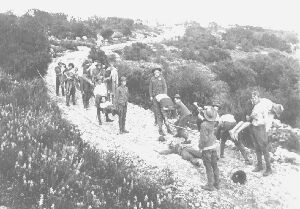 As in most councils, there were troops
active prior to the organization of councils. One
such troop was active in Sonora, TX in
1915. The photo was taken one day while
the troop was practicing their first aid on the dirt
road leading up to tAhe water works. The
road is still there today except that it is paved.
As in most councils, there were troops
active prior to the organization of councils. One
such troop was active in Sonora, TX in
1915. The photo was taken one day while
the troop was practicing their first aid on the dirt
road leading up to tAhe water works. The
road is still there today except that it is paved.