 |
Philmont Scout Ranch
The penultimate owner of Philmont was wealthy oil magnate and wilderness enthusiast Waite Phillips, who amassed a large part of the old land grant in the 1920s, totaling over 300,000 acres (1,200 km²). Phillips built a large residence in the lowlands of Philmont, and called it the Villa Philmonte. The ranch became a private game reserve for Phillips and his friends, and a number of hunting lodges and day-use camps were built. It would not have been beyond his means to bring electricity to those camps, but he decided not to. Some of these camps, including Fish Camp and the Hunting Lodge, have been preserved, complete with wood-burning stoves, oil lamps, and unique design features indicative of Phillips's often eccentric taste. Phillips sometimes allowed others to visit his ranch, including a few Boy Scout troops. He was so impressed with the Scouts that in 1938, he donated 35,857 acres (145 km²) to the Boy Scouts of America. They initially named it the "Philturn Rockymountain Scoutcamp" [sic]. The word 'Philturn' comes from Waite Phillips's name, together with the "Good Turn" he did by donating the property. In 1941, Phillips added more Philmont property, including the Villa Philmonte, bringing the total to 127,395 acres (516 km²). (Contrary to popular belief, Phillips did not give his entire ranch to the BSA, but only those properties that would have the most recreational value. The total donation comprised about 40% of the ranch.) To help fund the upkeep of Philmont, he threw in his Philtower office building in Tulsa, Oklahoma. The ranch's name was changed at this time to the "Philmont Scout Ranch and Explorer Base". Philmont was run differently in the early years than it is now. Half a dozen "base camps" were constructed at strategic locations. A visiting group of Scouts would stay at one of these camps for a week, and day-hike to surrounding locations of interest. If the Scouts wanted to visit a different area, they would pack up their gear, hoist it onto donkeys, and hike to another base camp. Eventually, possibly due to the advent of modern lightweight metal-frame backpacks and other backpacking technology, the program was restructured to be backpacking-based. In 1963, through the generosity of Norton Clapp, vice-president of the National Council of the Boy Scouts of America, another piece of the Maxwell Land Grant was purchased and added to Philmont. This was the Baldy Mountain mining area, consisting of 10,098 acres (41 km²). In recent
years, Philmont has also been able to gain use of
the Valle Vidal section of the Carson National
Forest. Since 1989, Philmont has had a series of
five-year special-use permits from the Forest
Service, allowing crews to hike and camp in the
Valle Vidal as part of their Philmont treks.
Philmont operates four staffed camps (Rich Cabins,
Whiteman Vega, Seally Canyon, and Ring Place) and
two trail camps in that part of the Valle. Those
camps serve around 3,000 Philmont campers each
summer. Each camper performs four hours of
conservation work in the Valle on projects approved
by the Forest Service. This
website will help you find the photo of your group,
provided that you know your expedition number.
Philmont has developed a photo archive of the
Philmont Treks. You click on the year on the
left hand side of the page and then look for your
photo. http://www.philmontscoutranch.org/PhotoArchive.aspx For
more information on Philmont go to:
Here are some treks to
Philmont from West Texas Philmont
Through The Eyes Of A Former Staffer
Return To Home Page |
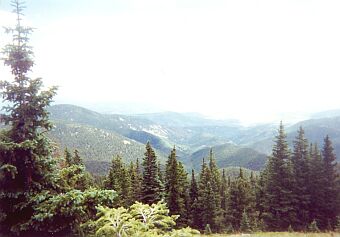 Philmont is
located in the Sangre de Cristo Range of the Rocky
Mountains of New Mexico. The closest town is
Cimarron, New Mexico, but perhaps it is better to
say that it is about 20 miles (30 km) west-northwest
of Springer, New Mexico, or 35 miles southwest of
Raton, New Mexico. It is shaped somewhat like the
letter 'I,' with the bottom section larger than the
top. It is about 12 miles across (east to west) at
its widest point, and about 30 miles (50 km) long.
There are no mountains to the south of Philmont, or
to the east (indeed, part of the eastern fringe of
the ranch is flatland) but the interior is quite
mountainous.
Philmont is
located in the Sangre de Cristo Range of the Rocky
Mountains of New Mexico. The closest town is
Cimarron, New Mexico, but perhaps it is better to
say that it is about 20 miles (30 km) west-northwest
of Springer, New Mexico, or 35 miles southwest of
Raton, New Mexico. It is shaped somewhat like the
letter 'I,' with the bottom section larger than the
top. It is about 12 miles across (east to west) at
its widest point, and about 30 miles (50 km) long.
There are no mountains to the south of Philmont, or
to the east (indeed, part of the eastern fringe of
the ranch is flatland) but the interior is quite
mountainous.