|
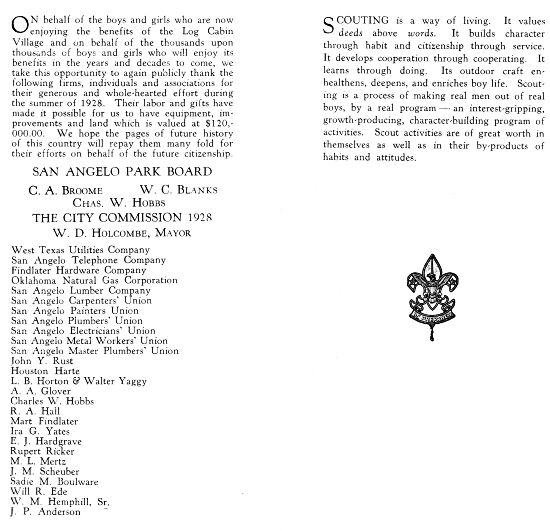
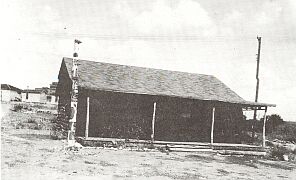
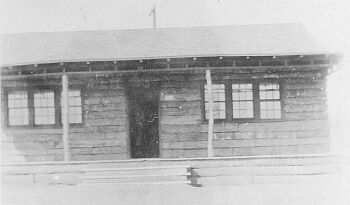
Boy Scout VillageJ. W. Crotty, Scoutmaster of Troop 1, during the Spring of 1928, conceived the idea of turning an old free tourist park, located along the North Concho River off Randolph street into a Boy Scout park and building cabins for each troop. The idea was revolutionary and new to Scouting. E. V. Spence, city manager, agreed that the day of the free tourist park had passed and that the police and health departments considered the camp a nuisance and source of trouble. Whisky and beer had been confiscated in park raids and doctors indicated they had been called there for treatment of drunks and drug addicts. The consensus of opinion was that the more desirable tourists were able to pay the charge of the private tourist camps located in San Angelo. The conversion of the park to the Scouts would also remove $75 per month on the park board in caretaking so they were in favor of the project. PETITION CIRCULATED"Whereas the maintenance of a free tourist park is in our opinion a needless expense on the taxpayers of San Angelo because of the fact that there are adequate privately-operated parks sufficient to care for all tourist needs. and "Whereas we believe the Boy Scout and Camp Fire Girl movements are greatly assisting in the proper training of our future citizens and that such movements are worthy of the fullest support, "Now, therefore, we the undersigned respectfully request the mayor, the city commissioners and the park board to move the free tourist park and turn over that part of the Santa Fe Park lying east of Abe street, with the exception of the approximately one half block of the park on the corner of Abe and Concho streets together with the improvements thereon to be used by the Boy Scouts and Camp Fire Girls for their activities with the privilege of erecting thereon suitable troop homes for the troops that are now organized or that may be created." It was explained by Brice Draper, Scout Executive, at the Commissioner's meeting that each individual troop house would be erected after a uniform plan, and the architectural design would be of the log cabin type. A portion of the park would be devoted to the establishment of an athletic field and used as a playground for the Boy Scouts and Camp Fire Girls. DESIGN OF VILLAGE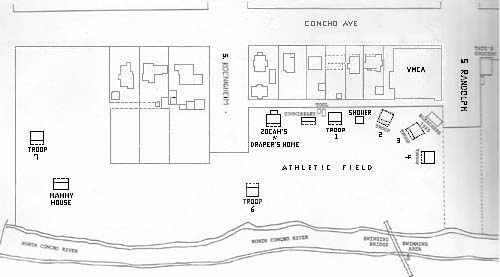 Roy K. Hamberlin, local architect, designed the cabins. Each cabin had an assembly room large enough for all Scout activities including games and formations. Each cabin also had five small rooms for patrol dens of each troop. The fifth room was the Scoutmaster's office. At one end of the assembly room a platform was built. A fireplace was supposed to have been built at the other end "depicting the traditions and history of the troop," but due to lack of funds, they were never added. An eight-foot porch was extended the length of each building. The cabins were modern in every respect, being piped with gas and wired with the latest approved lighting systems. The Village, as finally completed, included 14 buildings, seven Boy Scout troop cabins, a Camp Fire cabin known as the "Mammy House," a model kitchen, a complete washroom for boys and one for girls, two bath houses, and a commissary building. MAMMY HOUSETHE KITCHENHEADQUARTERS AND ZOCAH BUILDINGSWINGING BRIDGE 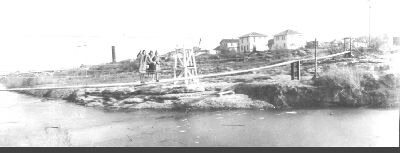 A swinging bridge built on
7/8 inch steel cables was swung high over the Concho River and led "to
the mystic council ring." It was located between the Abe street bridge
and the Chadbourne street viaduct. The bridge was supported by eight
primary cables of 35 tons, was 295 feet long, and was built with 3,500
feet of steel cable. The local union of the International Association
of Bridge Structural and Ornamental Iron Workers constructed the suspension
bridge.
SWIMMING AREA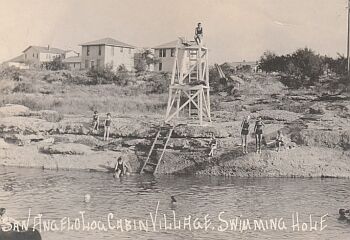 On
the South side of the river next to the swinging bridge, a complete swimming
beach was constructed equipped with swings and diving boards. The
floats in the swimming hole were anchored to the bridge during high water
to prevent their drifting away. Two platforms had been erected at
the swimming area. The two platforms were twelve and fourteen feet
high, respectively. According to Harold Albert, the diving boards
were made out of 2 by 12's and had to be replaced frequently because the
boys would break them. The swimming hole was to have had four double
diving boards and towers with three large floats. There were two
bath houses with lockers. On
the South side of the river next to the swinging bridge, a complete swimming
beach was constructed equipped with swings and diving boards. The
floats in the swimming hole were anchored to the bridge during high water
to prevent their drifting away. Two platforms had been erected at
the swimming area. The two platforms were twelve and fourteen feet
high, respectively. According to Harold Albert, the diving boards
were made out of 2 by 12's and had to be replaced frequently because the
boys would break them. The swimming hole was to have had four double
diving boards and towers with three large floats. There were two
bath houses with lockers.
ATHLETIC FIELD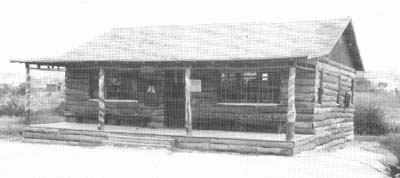 Of
all the improvements made at the Log Cabin Village, the athletic field
was the least remembered by the "Scouts" who were interviewed in 1988.
According to the original plans, there were to have been a one-eighth mile
cinder track, two basketball courts, two tennis courts, a general athletic
field, and archery range, a one and one-fourth mile canoe course and a
model swimming hole. Most of this was eventually built. We
do know that much of the dirt used in the track and athletic field came
from the excavation of the site on which the fourteen-story Hilton Hotel
was constructed. The soil was moved over to the Village by J. Lee
Vilbig and Company, excavators, for 75 cents per load. Of
all the improvements made at the Log Cabin Village, the athletic field
was the least remembered by the "Scouts" who were interviewed in 1988.
According to the original plans, there were to have been a one-eighth mile
cinder track, two basketball courts, two tennis courts, a general athletic
field, and archery range, a one and one-fourth mile canoe course and a
model swimming hole. Most of this was eventually built. We
do know that much of the dirt used in the track and athletic field came
from the excavation of the site on which the fourteen-story Hilton Hotel
was constructed. The soil was moved over to the Village by J. Lee
Vilbig and Company, excavators, for 75 cents per load.
In talking with several "Scouts" of that day I found that the swimming area and athletic field were different from year to year depending on when the Scouts were active in Scouting at the Village. Some said there was a cinder track, others said there was not one. Some remembered the diving platforms; others did not. They all agreed that they played games and had contests on the grounds (athletic field) in front of the cabins and that they did go swimming in the river and there were diving boards there. There were several floods on the river and I'm sure that the equipment found at the swimming area changed depending on what was replaced after each flood. One of the Scouts, Edwin B. Buttery, said the playing field was barren of grass or any other kind of covering. He said the ground was as hard as a rock and when you fell down you usually managed to skin yourself up. STUNT NIGHTThe night of the program, they were to have given away a new Ford Cabriolet car donated to them by John Y. Rust, then president of the Concho Valley Council, in a lottery. But due to a ruling by W. A. Stroman, County Attorney, on the meaning of "lotteries" they decided to sell the car instead as it was against the law to have a lottery in Scouting. The money raised from the sale of the car was used for the Village construction costs. CONSTRUCTION OF THE VILLAGETroop 2's
cabin showing 'Her Majesty Queen Totem"
 The
oak slabs used on the outside of the buildings were given to them by J.
P. Holmes of Arkansas, who was connected with the San Angelo Lumber Company.
When the log slabs came into San Angelo on railroad cars, they were unloaded
by Reece and Harold Albert and stored in the backyard of their family home
on Bell street. When the construction crews were ready for the logs,
they were then hauled over to the Village. The
oak slabs used on the outside of the buildings were given to them by J.
P. Holmes of Arkansas, who was connected with the San Angelo Lumber Company.
When the log slabs came into San Angelo on railroad cars, they were unloaded
by Reece and Harold Albert and stored in the backyard of their family home
on Bell street. When the construction crews were ready for the logs,
they were then hauled over to the Village.
In addition to the oak slabs, around $350 worth of lumber from Camp Kickapoo was also used in the buildings. Findlater Hardware Company donated the fittings and gas pipe for the Zocah house and three troop houses. The Master Plumbers Association, the Axtell Plumbing company and the Franklin Supply Company donated gas water heaters and other supplies. The Bunyard Electrical Company, Bullock and Taylor, and Braden Hudson and Wangler furnished wire and conduit.
By that evening five troop houses and a Knights of Zocah Lodge building were nearly erected with most of the rough electrical and plumbing work completed. DEDICATION OF VILLAGEFINALLY DEDICATED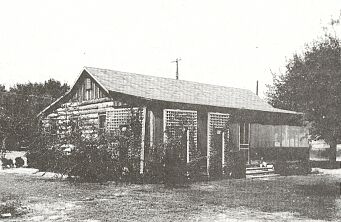 Finally,
on September 3, 1928, the Log Cabin Village was dedicated. The occasion
was the labor union's annual picnic. In a simple, but impressive
presentation and flag-raising ceremony witnessed by more than 500 persons,
the Village was formally dedicated. J. W. Scheuber, Scout commissioner
and a director of the Camp Fire Girls' organization , acted as master of
ceremonies. The Village was formally presented in a short speech
by Mayor W. D. Holcomb. Speeches of acceptance were made for the
Boy Scouts by John Y. Rust, president of the Scout Council, and for the
Camp Fire Girls by Walter Yaggy, vice-president of the council. Scout
Executive Brice Draper was at a Scout Executives' Training School at Cornell
University at Ithaca, New York, and was not able to be present for the
ceremonies. Finally,
on September 3, 1928, the Log Cabin Village was dedicated. The occasion
was the labor union's annual picnic. In a simple, but impressive
presentation and flag-raising ceremony witnessed by more than 500 persons,
the Village was formally dedicated. J. W. Scheuber, Scout commissioner
and a director of the Camp Fire Girls' organization , acted as master of
ceremonies. The Village was formally presented in a short speech
by Mayor W. D. Holcomb. Speeches of acceptance were made for the
Boy Scouts by John Y. Rust, president of the Scout Council, and for the
Camp Fire Girls by Walter Yaggy, vice-president of the council. Scout
Executive Brice Draper was at a Scout Executives' Training School at Cornell
University at Ithaca, New York, and was not able to be present for the
ceremonies.
The dedication program followed a huge holiday celebration by the Central Labor Union and affiliated organizations, which had a parade through the business section of the city at 9:30 a.m., speeches and addresses, a barbecue dinner at noon, and a medley of sport events during the afternoon. DEDICATION PROGRAM FILMED Three
newsreel cameras filmed the program. Guy H. Allbright, staff cameraman
for the Pathe Company, and Fred Backelman, who had charge of a district
composed of the whole of Oklahoma and Texas, took shots of the event.
A third cameraman, representing the Fox Company, took pictures of the parade
from top of the Naylor Hotel. Three
newsreel cameras filmed the program. Guy H. Allbright, staff cameraman
for the Pathe Company, and Fred Backelman, who had charge of a district
composed of the whole of Oklahoma and Texas, took shots of the event.
A third cameraman, representing the Fox Company, took pictures of the parade
from top of the Naylor Hotel.
NOTE PAID OFFSECOND ANNIVERSARYVILLAGE WASHED AWAY
Last Updated: June 7, 2010 Return to Home Page |
 The
West Texas Utilities Company donated the fixtures, sending word for the
Scout Executive to "come and pick out what he wants and take it away."
Members of the International Brotherhood of Electrical Workers Labor Union
No. 251, Journeymen Plumbers Local 553, men of the San Angelo Lumber Company,
carpenters of West Texas Utility Company and Local 411, the Huntoon Roofing
Company and many others donated their labor to build the Village.
On Saturday, July 14, 1928,
over 200 workmen were at the building site. J. E. Parry was in charge
of the carpenters, J. L. Anger, the plumbers, L. L. Gilbert was Chairman
of the electrical union men, Joe C. Huntoon had charge of putting on the
roofs, and J. W. Crotty was in charge of some eighty Boy Scouts who were
used as water boys and helpers to the workmen. W. A. Stroman, County
Attorney, donated 150 pounds of meat which was barbecued by Fire Chief
John Parker for dinner. Miss Elizabeth Fowler had charge of serving
the hungry workers.
The
West Texas Utilities Company donated the fixtures, sending word for the
Scout Executive to "come and pick out what he wants and take it away."
Members of the International Brotherhood of Electrical Workers Labor Union
No. 251, Journeymen Plumbers Local 553, men of the San Angelo Lumber Company,
carpenters of West Texas Utility Company and Local 411, the Huntoon Roofing
Company and many others donated their labor to build the Village.
On Saturday, July 14, 1928,
over 200 workmen were at the building site. J. E. Parry was in charge
of the carpenters, J. L. Anger, the plumbers, L. L. Gilbert was Chairman
of the electrical union men, Joe C. Huntoon had charge of putting on the
roofs, and J. W. Crotty was in charge of some eighty Boy Scouts who were
used as water boys and helpers to the workmen. W. A. Stroman, County
Attorney, donated 150 pounds of meat which was barbecued by Fire Chief
John Parker for dinner. Miss Elizabeth Fowler had charge of serving
the hungry workers.