 |
||
4TH NATIONAL JAMBOREE - 1957Buffalo Trail Council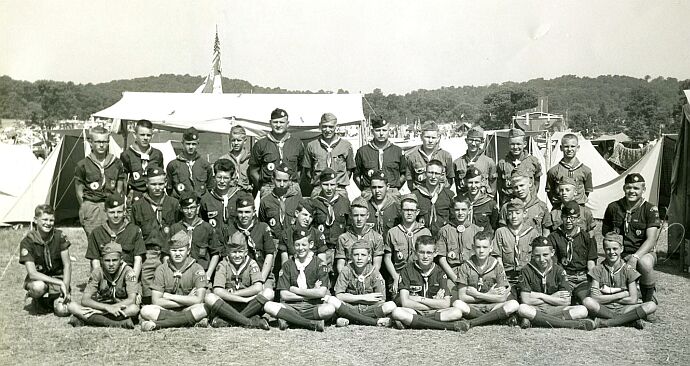
Troop 20 Section 22 Region 9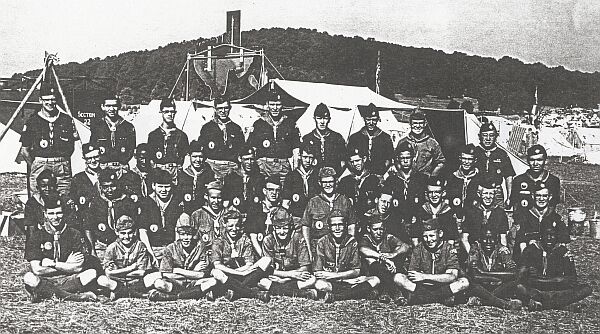 Possibly Troop 19?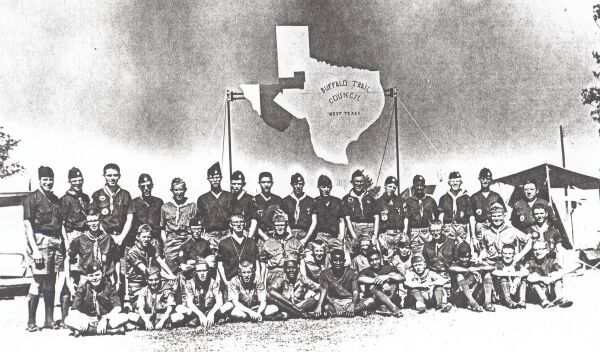
1957 Jamboree Travels of Troop 18, Odessa, Texasby Jim MayoBut the Jamboree really began for us about midday on July 12th when we boarded a Texas & Pacific Railway train that was just for us. Scouts from El Paso were already on board and we picked up Scouts in Midland and perhaps one town afterwards. We arrived in the Ft. Worth-Dallas area in the evening, and for many of us, eating a meal in a dining car was a new experience. By the next morning we were traveling through Arkansas. The train stopped in St. Louis’s Union Station, and we all took the opportunity to buy candy, soft drinks, and souvenirs. By dusk we were traveling through Cincinnati, and by the next morning, we reached our first major stop, Washington, D.C. U.S. Representative J.T. “Slick” Rutherford met Troop 18 as Scouts disembarked the train, and we were impressed that a Congressman would take the time to meet us. The Odessa American published a photograph of that moment, and surely our parents were glad to know that we were well. We started our day in the nation’s capital with a Gray Line bus tour. We saw the U.S. Capitol where a photo of our troop was taken. Having a box lunch, we then saw the Lincoln Memorial and the Jefferson Memorial, and other Washington sites. Later in the day, we visited Mount Vernon and returned to D.C. An unforgettable event was our taking a swim in the pool in the Ambassador Hotel, some with suits and others skinny-dipping. We thought it was to let us have a good time, but in retrospect, the trip planners probably thought it was about time for us to have a bath! That evening we re-boarded the train and arrived the next day in Philadelphia. In 1957 Philadelphia was undergoing urban renewal as the Independence Mall was under construction. But amid that change, we toured Independence Hall, Carpenters Hall and saw the Liberty Bell. After seeing these sites we visited the Philadelphia shipyard and toured a World War II submarine. We then boarded our train to nearby Valley Forge. Our campsite was less than a quarter mile from the Memorial Arch. Daily life included preparing meals, taking the daily shower, and finally falling asleep. The Jamboree was filled with wonderful events and attractions. We could earn the Jamboree Adventure Award, which meant participating in events such as marksmanship, first-aid, orienteering, ropework, archery, friendship exchange, visiting historical sites, and other events. One of the best places to visit was the Gothic-style Washington Memorial Chapel. Whittlin Jim’s column in Boy’s Life included the neckerchief slide-of-the-month, and the winners from a national competition were in a special display. Those who saw it were impressed. Trading patches and regional items was a big deal. Everyone wanted a Region 9 patch but it was hard to find and typically cost too many patches. One Scout sold horned toads for $1.25 apiece and trading a Mexican bullwhip for a pair of leather moccasins made in Maine. Everyone considered our first Takanka OA lodge patch (the buffalo with testicles) to be worthless because it was not fully embroidered and had few colors. But that lodge patch now sells on EBay for over $300, and region patches are sold for only a nominal amount! The big evening shows were
opening and closing nights. On that first night, we saw the largest display
of fireworks any of us had ever seen, and perhaps even so to this day.
Vice-President Nixon spoke to us one of these evenings. Daily shows included
the Big Top Circus and seeing the Lennon Sisters. The closing night was
memorable. Each of the 52,580 Scouts lit a candle in the Jamboree arena,
and we heard a recorded message from the late Lord Baden-Powell. Staying
one more day and closing camp, some Scouts went to the Jamboree arena in
the evening to roll down the hill in 50-gallon barrel drums.
In the morning we arrived in Detroit, Michigan. We first toured the Ford Motor Company’s assembly plant, seeing a caldron pouring steel and watching the car assembly line. Later, we took a bus to Greenfield Village, established by Henry Ford to preserve American life. We walked by Thomas Alva Edison’s original laboratory, moved from Menlo Park, New Jersey, as well as stopping by Wilbur and Orville Wright’s original bicycle shop. Many of us enjoyed a ride on a scaled-down version of a Mississippi riverboat. We returned to our train and that evening we made our final stop, a short one at Union Station in St. Louis. The remainder of the trip was a long ride until we finally arrived back to Odessa. Without a doubt, all of us were looking forward to a home cooked meal. Looking back, for most of us it was our farthest trip away from West Texas. We saw places and met Scouts entirely different from what we were familiar in our hometown. Our three-week journey trip was unforgettable and remains part of us. Below is what another person remembers about the trip to the Jamboree from the council.A group of eager Scouts and Explorers were standing close to the tracks at the Texas and Pacific depot, the "Texas and Pacific Boy Scout Special" was pulling in from El Paso. The kids and their leaders were ready to board the train and head for the 1957 National Jamboree at Valley Forge, Pa. The "TP Special" had started in El Paso and would pick up Scouts all the way to Longview, and then roll on across the United States to Valley Forge, with many interesting stops and visits along the way. The highlight of the trip to Valley Forge was a visit to Washington D.C., where the "TP Special" was met by J.T. Rutherford, Congressman, 16th District of Texas. The kids did many interesting things in Washington. They visited the Capitol, the White House and the Jefferson and Lincoln Memorials. At Arlington National Cemetery they saw the guard change at the Tomb of the Unknown Soldiers. A trip that would never be forgotten was the visit to Mount Vernon, the home of George Washington. The stately old mansion is situated at the crest of a slope overlooking the Potomac River. George and Martha Washington are buried at Mount Vernon, and thousands of Scouts visited their last resting place during the National Jamboree. When the "TP Special"
pulled into Valley Forge, the boys were shown to their camping area. A
tent city so big that it was hard to believe was going up before their
eyes. In only 72 hours there was 25,000 tents pitched. There were 52.580
boys and leaders at the 4th National Jamboree, and every one of them was
at the opening night show. There were also 30,000 visitors. A theatre carved
out of a hillside before the Jamboree and about the size of Yankee Stadium,
held the Scouts and visitors.
The fireworks would never be forgotten, as the Scouts looked skyward, they saw an illuminated cross and star of David, as aerial bombs, parachute bombs, musical shells and some three hundred aerial shells hissed and sparkled five hundred feet up in the dark sky. Every day of the Jamboree things happened that would never be forgotten. A trip to New York and a visit to Rockefeller Center and the Empire State Building, a boat ride out to see the Statue of Liberty, a visit to Radio City and then a tour of the United Nations. A special train carried the Scouts into Philadelphia for a visit to Independence Hall where they viewed the Liberty Bell, Carpenters Hall, where in 1774 the first Continental Congress met, and the home of Betsy Ross, who made the first American Flag. A big treat for the Scouts was a tour of the U.S.S. Hake, a submarine that was launched on the 17th of July, 1942. The submarine was named for a North American game fish, the Hake. The boat operated against German U-Boats for about a year out of Scotland and off the Azores. In 1943 she made the long trip to the Pacific and by the Ist of 1944 she was in Phillipine waters on patrol against the Japanese. Her first sinking took place there, an enemy tanker fell prey to her torpedoes. During this period she sank another ship, two more tankers, a destroyer and a fully-loaded troop transport was blown in two and sunk, also during this period she rescued 29 downed American airmen. At Valley Forge, Washington Memorial Chapel, a magnificent building was inspired by the story of Washington's pra3er. The building is famed for its Carillon of 56 bells, and the Valley Forge Museum of American History. Among the many museum exhibits is Washington's tent, or marquee, in which he spent the first week at Valley Forge. Replicas of log cabins such as those built by Washington's Continental Troops have been erected over Valley Forge. A lot of tall tales were told at Valley Forge during the Jamboree. One of the tales said that if all the cows required to furnish the Jamoree milk supply were standing at 34th and Broadway and swished their tails together, the wind would blow off the top fifty-seven stories of the Empire State Building over a block away. One of the West Texas kids was bragging to a group from the East Coast about how his group had brought a Bald Eagle to the Jamboree. He told his eager audience to come over for a visit and they could see him. When they got to the Texas area he showed them his Scoutmaster, as Eagle for many years and bald as a billiard ball. The youth proudly explained, "There he is, a bald Eagle". The flag-raising and flag-lowering ceremony was an event that every Scout wanted to see. Besides the U.S. flag, there were flags of every country that had Scouting, sixty three of them! When they went up, they went up to the blare of bugles, and the thunder of drums, and when they came down, they came down to brass bands and bursting bombs. On the Sunday morning that the Scouts were at the Jamboree, 52.000 of them went to church, there were thirteen different services held that morning on the Jamboree grounds. Nationally known religious leaders conducted the services. The Scouts worshiped in the faith of their choice. There were guest at the Jamboree from all over the world. Some of them came half way around the world to get there, they came from Canada and from "down under" Australia, Venezuela, England, Israil, Japan, and many other countries. The Thunderbirds, the U.S. Air Force official aerial demonstration team put on a show that no one will ever forget. They did precision four-point and eight-point rolls, an inverted pass, aileron rolls and vertical rolls. Climaxing the performance with the spectacular "bomb burst". They headed straight up in a diamond formation, each plane, with a roar from its after-burner, broke out of the diamond formation and left a track of smoke in the sky like an exploding bomb. Then they rolled and dove towards the ground. leveled off, turned and at speeds up to 750 mph, roared into the 'YVild Blue Yonder". The last night of the
Jamboree - - - and what a night it was, the story of Baden Powell, the
great Englishman who founded Scouting so many years ago, was told. Each
Scout had a candle, and when the lights were turned off, over 52,000 candles
flamed up to light the huge area. It was a moment that everyone who was
there will always remember. And then the Jamboree was over, the tents
came down, you saw a city vanish before your eyes. The Scouts bearded their
buses, planes, and trains and
The Texas Scouts bearded the "TP Special" and began the long trip back to West Texas. There was stops along the way, the first was at Niagara Falls, it was something to see the great falls, especially at night with the lights on them. Then there was a trip into Canada, and on to Detroit, the automobile capital of the world. There was a lot of things to see in this city, but the highlight was a tour of the huge Ford Motor Company. The Scouts followed along the assembly line and saw a shining new car come off the line in a matter of minutes. Then the "TP Special" was on its way again. At Longview the Scouts began to unload, and as the train rolled on across Texas, one by one the groups left to return to their homes. Just after sunrise the
train reached Odessa, a happy but tired group of Scouts got off, and the
train rolled on Westward, the Scouts took one last nostalgic look at it.
The long journey was over, but would never be forgotten. It was the highlight
of their scouting career.
Information for this page and quotations were taken from West-Texas, Cubs, Scouts and Explorers, by Olan B. Draper. Our thanks to David O'Neill for providing us with photos of the troop. We want to thank James M. Mayo, Jr. for provided us the group photo of Troop 18, a list of the members of that troop, and his story about the Jamboree. Last Updated: August 26, 2010 |